"STOMP"
An interactive walking platform for communities to address waste production cycles caused by mindless overconsumption.
An interactive walking platform for communities to address waste production cycles caused by mindless overconsumption.
Sustainable Systems
Sustainable Systems
Industrial Design
Industrial Design
Interaction
Interaction
About the Project
"STOMP" examines how everyday waste is encountered in shared public space. Public disposal systems are necessary, but they often make waste feel too clean: something used, dropped into a bin, collected, sorted, and removed before it has to be meaningfully seen. My entry point was personal-throwing away cans regularly and realizing how little friction existed between consumption and forgetting.
To test that instinct, I looked at waste data, interviewed residents, observed sites where cans collect, mapped disposal patterns, and spent time in communal settings where objects and responsibility are shared differently. The research shifted the project away from waste management and toward visibility, behavior, and public interaction.
The aluminum can became the symbol of disposable overconsumption because it was the exact reason it was invented for and gave the project a wider view than just aluminum cans. "STOMP" places that can inside a shared path, where walking becomes a decision: step, avoid, or move around it. The outcome is a simple intervention that makes disposal visible, tactile, and collectively felt.
Type
Industrial design, Public Intervention,
Sustainable Systems
Year
2026
Context
Pratt Senior Thesis Project
View Full Case Study

"STOMP" Hero prototype
What
What
"STOMP" is a public intervention that makes discarded material visible within everyday movement. It uses the act of walking to question how quickly waste disappears from attention once it leaves the hand.
“STOMP” is a public intervention that makes discarded material visible within everyday movement. It uses the act of walking to question how quickly waste disappears from attention once it leaves the hand.

Material specific waste generation

Containers only waste treatment

Recycling rate of beverage cans
Why
Why
I was throwing away multiple cans a day, but the problem was not just the number of cans. It was how little friction existed between using something and forgetting it. Disposal made the material disappear before I had to understand my own role in the system. "STOMP" responds to that gap by making waste visible, physical, and harder to passively ignore.
I was throwing away multiple cans a day, but the problem was not just the number of cans. It was how little friction existed between using something and forgetting it. Disposal made the material disappear before I had to understand my own role in the system. “STOMP” responds to that gap by making waste visible, physical, and harder to passively ignore.

(Click on map to zoom)
Initial research phase mind map

Form and mechanism iterations

Volunteering at the migrant shelter
How
How
The project started from my own daily overconsumption, but I did not want to build from guilt alone. I tested that instinct through interviews, waste data, site visits, mapping, and community experience, looking at how cans move from casual use to public residue. Observations in places like theaters and bars showed how quickly consumption turns into disposal, while volunteering at a migrant shelter gave me a sharper contrast: environments where resources and responsibility are felt more collectively.
From there, I moved into sketches, material tests, tile mechanisms, and prototypes, refining "STOMP" from a recycling idea into a public interaction surface.
The project started from my own daily overconsumption, but I did not want to build from guilt alone. I tested that instinct through interviews, waste data, site visits, mapping, and community experience, looking at how cans move from casual use to public residue. Observations in places like theaters and bars showed how quickly consumption turns into disposal, while volunteering at a migrant shelter gave me a sharper contrast: environments where resources and responsibility are felt more collectively.
From there, I moved into sketches, material tests, tile mechanisms, and prototypes, refining “STOMP” from a recycling idea into a public interaction surface.
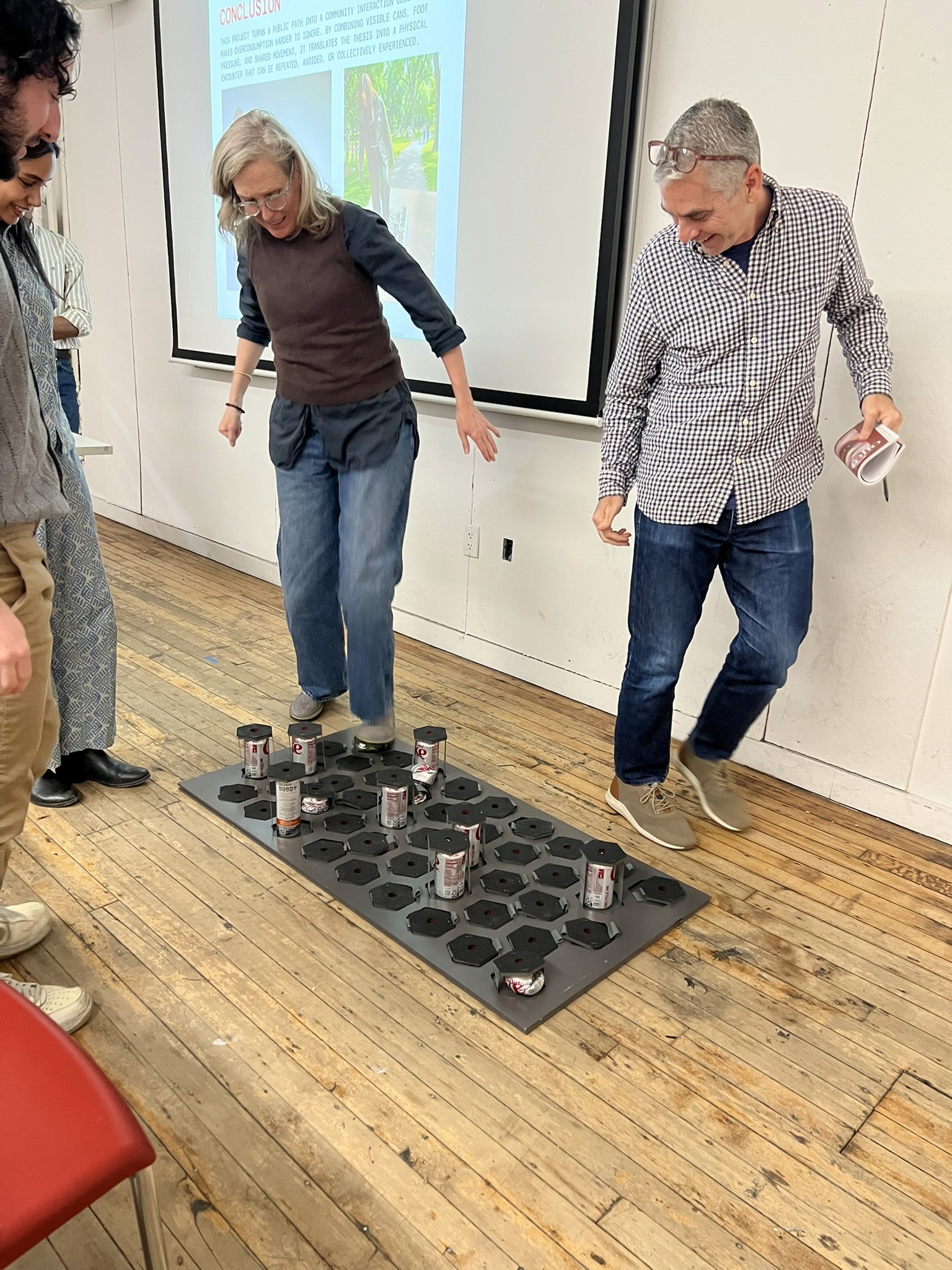
Pratt industrial design faculty interacting with "STOMP", Senior Thesis 2026
(Video) Interaction with "STOMP"
(Video) Removing can after interaction
Then
Then
"STOMP" gave me a way to test whether waste could be made visible without relying on signs, guilt, or instruction. The final prototype worked because the interaction stayed simple: a person either steps on the tile and changes the can through pressure, sound, and deformation, or moves around it and still has to register its presence.
That choice was the outcome. The can stopped being background material and became something people had to notice in relation to their own movement. I learned that a project does not need to explain everything if the condition is clear enough. By placing a familiar object in the path, "STOMP" turned overconsumption into something immediate, physical, and briefly shared.
“STOMP” gave me a way to test whether waste could be made visible without relying on signs, guilt, or instruction. The final prototype worked because the interaction stayed simple: a person either steps on the tile and changes the can through pressure, sound, and deformation, or moves around it and still has to register its presence.
That choice was the outcome. The can stopped being background material and became something people had to notice in relation to their own movement. I learned that a project does not need to explain everything if the condition is clear enough. By placing a familiar object in the path, “STOMP” turned overconsumption into something immediate, physical, and briefly shared.