Easel
Easel
Product design and brand identity for a conceptual fractional art investment platform.
Product design and brand identity for a conceptual fractional art investment platform.
Finance
Finance
Art & Culture
Art & Culture
Concept
Concept
Product Design
Product Design
Brand
Brand
About the Project
Easel began before I knew what the product would be. I had been thinking about the kinds of problems I was naturally drawn to—systems that ask people to make decisions without ever making them feel fully in control. Around the same time, I came across the sale of a Monet for nearly $50 million. I loved the work, but the number made me curious about something else: whether ownership of important art could ever become more accessible without changing what made the art valuable in the first place.
I started at The Met, watching how people encountered art before bringing money into the conversation. Familiarity drew crowds; personal meaning held attention; sometimes appreciation became participation. Interviews made the premise harder, and therefore more useful. Art students needed clarity, investors needed evidence, and artists wanted the work to retain its cultural meaning. Looking at brokerages, marketplaces and existing fractional-art platforms showed me that none resolved all three particularly well.
Easel grew out of that gap. I developed a model in which museums could retain and exhibit significant works while fractional ownership created a separate investment layer around them. From there, the product became an exercise in balancing two forms of value: giving people enough financial structure to make an informed decision, while keeping the artwork—not the transaction—at the centre of the experience.
Type
Product Design, UX, Brand Identity
Year
2026
Context
Individual academic project
View Full Case Study

Brand identity experimentation for Easel
What
What
Easel is a platform for fractional ownership of significant works of art. I began with the idea of making access broader, but quickly became more interested in what could be lost when collecting starts to behave like trading.
Easel is a platform for fractional ownership of significant works of art. I began with the idea of making access broader, but quickly became more interested in what could be lost when collecting starts to behave like trading.
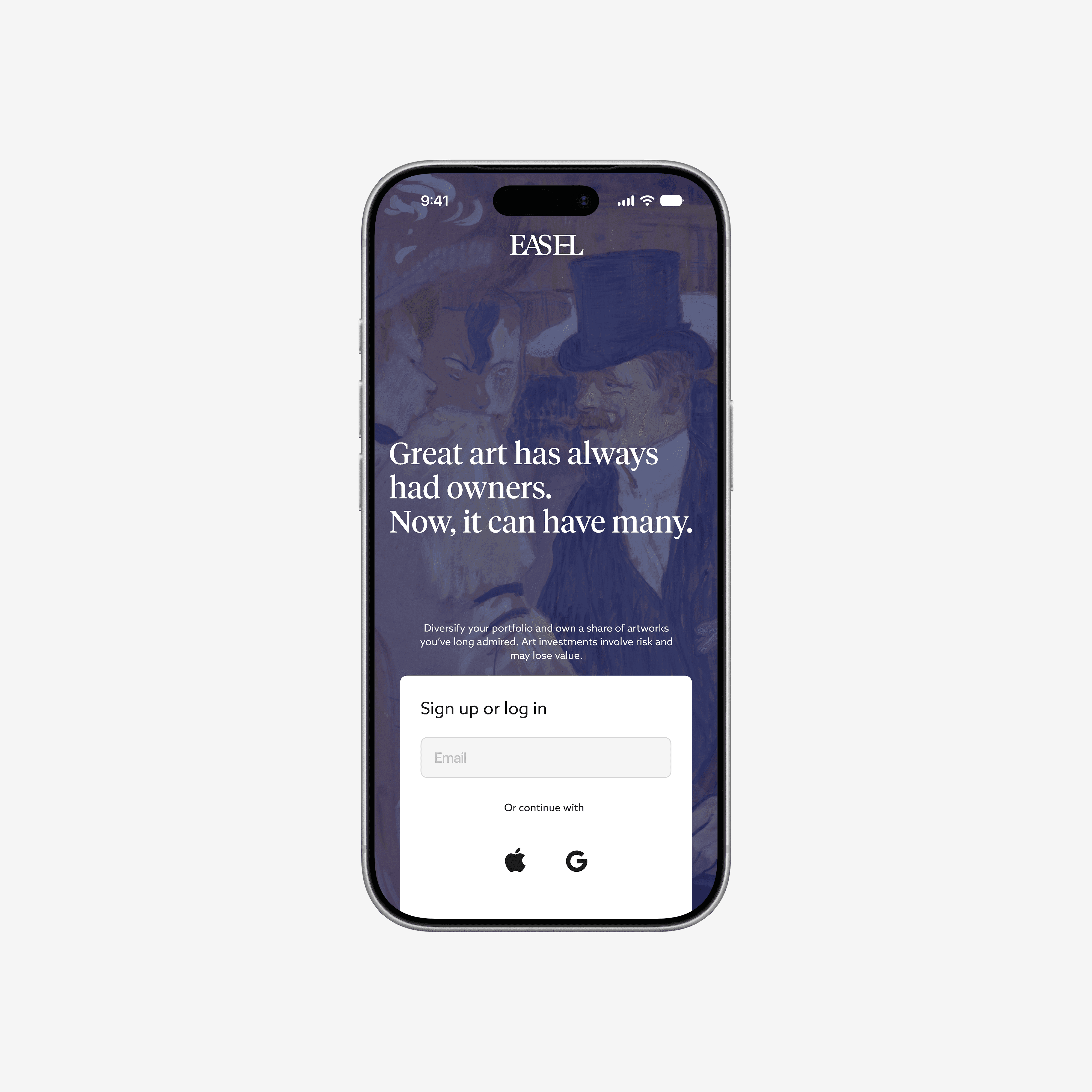
New user. Onboarding
(Video) Return user, Home
Why
Why
Art can carry enormous cultural and financial value, yet meaningful ownership is still limited to very few people. I wanted to explore what it would mean to open that relationship up without making art feel like just another asset.
Art can carry enormous cultural and financial value, yet meaningful ownership is still limited to very few people. I wanted to explore what it would mean to open that relationship up without making art feel like just another asset.

User journey map of the partial working flow
(Video) Explore
(Video) Artwork Details
(Video) Financial Data
How
How
I began by treating Easel less like a marketplace and more like an information system. I focused on what someone needed to understand before acting, then built the experience around clarity, pacing and deliberate restraint rather than constant prompts to transact.
I began by treating Easel less like a marketplace and more like an information system. I focused on what someone needed to understand before acting, then built the experience around clarity, pacing and deliberate restraint rather than constant prompts to transact.
Then
Then
Easel started as a question about access to art, but the harder problem was making fractional ownership understandable without borrowing the habits of a trading platform. I spent most of the project working through that tension in the product itself, how ownership is explained, when performance appears, what information belongs before a transaction, and where the experience should slow down. The visual identity developed alongside those decisions, giving the interface a quieter, more editorial character without getting in the way of the financial information.
By the end, I was thinking much less about individual screens and much more about how product structure, interaction and visual language could reinforce the same idea.
Easel started as a question about access to art, but the harder problem was making fractional ownership understandable without borrowing the habits of a trading platform. I spent most of the project working through that tension in the product itself, how ownership is explained, when performance appears, what information belongs before a transaction, and where the experience should slow down. The visual identity developed alongside those decisions, giving the interface a quieter, more editorial character without getting in the way of the financial information.
By the end, I was thinking much less about individual screens and much more about how product structure, interaction and visual language could reinforce the same idea.